The New Scoreboard for Hyperscalers
For most of the cloud industry’s history, competition revolved around straightforward metrics: processing power, uptime, global footprint, and price. AWS, Google Cloud, and Microsoft Azure grew by offering faster, cheaper infrastructure with more services attached. Operational issues — security lapses, cooling choices, resource consumption — were mostly managed behind the scenes.
That is changing. Enterprise customers are asking harder questions before signing multi-year contracts. Regulators in Europe and beyond are scrutinizing data center water withdrawals and energy sourcing. Boards now hold CISOs accountable not just for budgets, but for breach outcomes. Cloud providers are responding accordingly, and the headlines around Microsoft this week illustrate exactly how that response looks in practice.
Security Is a Structural Problem, Not Just a Personnel Story
Microsoft named a new chief digital safety officer, continuing a pattern of security leadership changes that began in earnest when the company launched its Secure Future Initiative. That initiative was a direct response to a string of high-profile security incidents, including a breach of Exchange Online email accounts and an accidental exposure of tens of terabytes of internal data.
What matters here is not who holds which title, but the institutional logic behind the moves. The Secure Future Initiative signals that Microsoft is treating security as a structural engineering problem rather than a management one. The stated goals include wider adoption of memory-safe programming languages, automated vulnerability scanning through tools like CodeQL, and doubling the speed at which cloud vulnerabilities are patched. Whether those commitments translate into measurably fewer incidents over time remains genuinely unknown — a leadership change is not itself evidence of improved security outcomes.
Separately, Microsoft has been pushing its AI-driven security operations platform, where it was recently named an Overall Leader and Market Leader in KuppingerCole’s 2026 Emerging AI Security Operations Center report. The argument being made to enterprise buyers is that security operations can no longer scale on human effort alone: AI-assisted incident prioritization, automated attack disruption, and agent-assisted triage are being positioned as table stakes for any serious cloud security offering.
Cooling the Machines — Literally
The water efficiency story is where physical infrastructure meets brand strategy in an unexpectedly direct way.
Data centers require enormous amounts of electricity to run, but they also require cooling — and cooling has traditionally meant water, in large quantities. Microsoft reportedly used 1.69 billion gallons of water in 2022, a 34 percent jump from the prior year. That figure drew public scrutiny in communities where large facilities were being built or expanded.
The numbers Microsoft disclosed this week tell a different story, at least for now. The company claims to have achieved water positivity across its global operations in fiscal year 2025 — five years ahead of its original 2030 target. More specifically, it reports reducing its average water use effectiveness (WUE) from 2.3 liters per kilowatt-hour in the early 2000s to 0.27 liters per kilowatt-hour in 2025, a near-90 percent improvement. For context, the industry average WUE sits around 0.84 liters per kilowatt-hour, though Amazon claims an industry-leading 0.12 liters per kilowatt-hour.
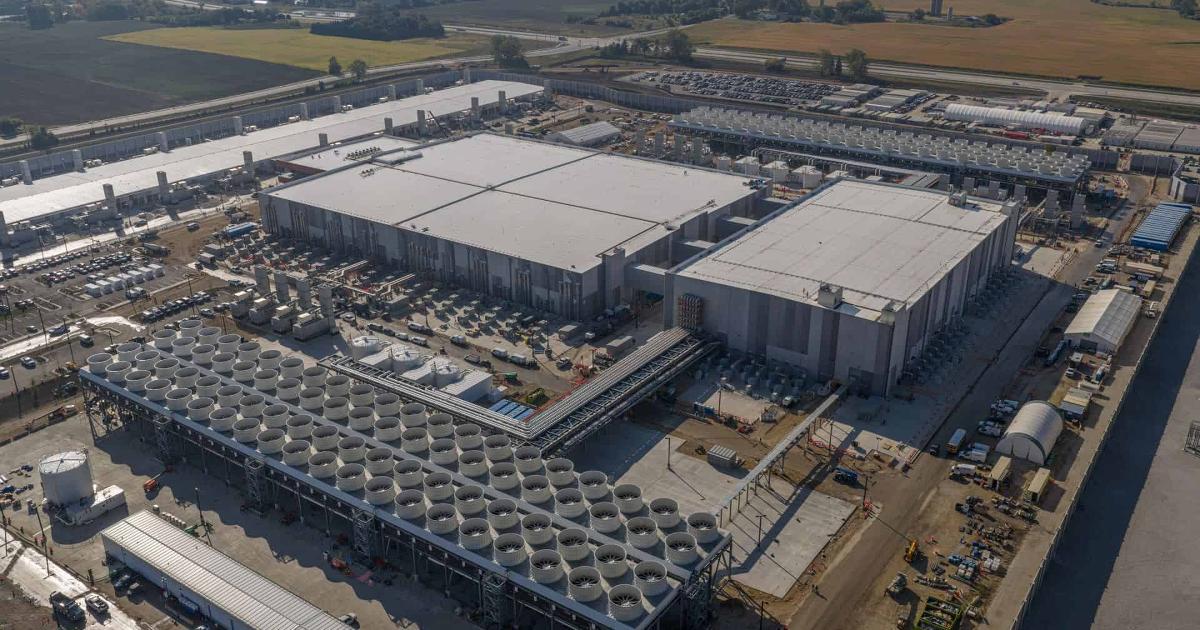
The technical driver behind the improvement is a shift from evaporative cooling — which consumes water as it evaporates to dissipate heat — toward direct air cooling and a new closed-loop liquid cooling system designed specifically for AI hardware. The closed-loop design recirculates recycled water inside a sealed system, meaning it does not continuously consume fresh water the way older cooling towers do. This matters because AI workloads generate significantly more heat per rack than conventional cloud computing, making "opening the window" — as one Microsoft engineering executive put it — no longer a viable option.
Microsoft has also invested more than $500 million in water and wastewater infrastructure projects since 2020, including $25 million in upgrades in Leesburg, Virginia. These projects help local utilities produce the recycled or non-potable water that Microsoft’s data centers increasingly rely on.
That said, the company itself acknowledges that sustaining water-positive performance as its data center fleet expands remains an ongoing challenge. Environmental claims made by corporations are company-reported figures, and direct comparisons between hyperscalers are tricky because cooling design, local climate, and accounting methodology all vary. These numbers deserve scrutiny, not blanket acceptance.
What Microsoft Is Signaling Across Three Announcements
| Announcement | Surface-level story | Deeper operational signal |
|---|---|---|
| Security leadership changes & Secure Future Initiative | Personnel reshuffle | Treating security as an engineering discipline, not just a management function |
| AI-assisted SOC and cloud resilience tools | New product features | Selling reliability and response speed as core infrastructure value |
| Water efficiency & water-positivity milestone | Sustainability milestone | Physical resource management as a competitive and regulatory necessity |
Operational Trust as a Differentiator
What ties these three threads together is the concept of operational credibility. Cloud platforms have largely solved the basic availability problem — a major outage at AWS or Azure is now news precisely because it is rare. The next layer of competition is about what happens when something does go wrong, whether that is a security incident, a service disruption, or a community backlash over water consumption.
None of this week’s announcements alone establishes a durable market trend, and Microsoft is far from the only company making moves in these areas. But the fact that a single company can generate significant industry coverage in one week from security operations, cloud resilience tooling, and water efficiency tells you something about where the conversations in cloud procurement, regulation, and public relations are heading.
The cloud market’s next phase isn’t just about who has the most data centers. It is increasingly about who can credibly demonstrate they are running them responsibly.
Sources
- Microsoft announces major security leadership reshuffle, appoints new CISO – SiliconANGLE
- Microsoft named an overall leader in KuppingerCole Analyst’s 2026 Emerging AI Security Operations Center (SOC) report | Microsoft Security Blog
- Microsoft claims water positivity across data center operations
- Microsoft reaches water efficiency milestone